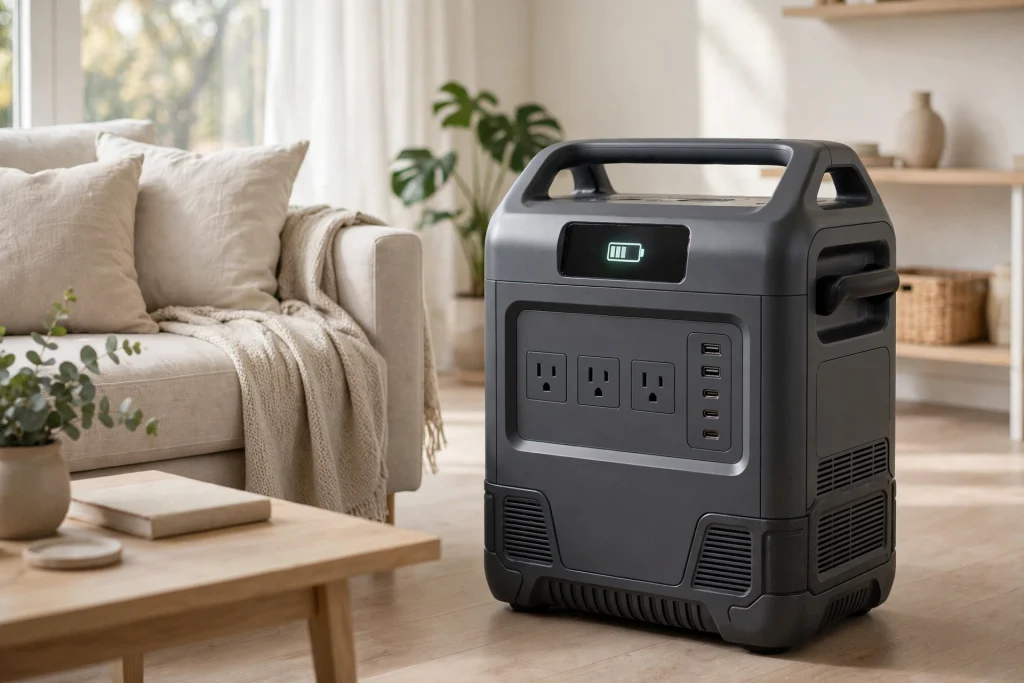
Anker just announced the biggest power station it has ever sold. The SOLIX S5000 goes on sale October 27, and the launch pricing is aggressive.
Key Takeaways
- Anker announced the SOLIX S5000 on October 9: 5,024Wh, 4,500W dual-voltage 120V/240V output, expandable from 5kWh to 30kWh.
- Launch pricing: US$3,599.99 MSRP with a US$1,100 launch discount to US$2,499.99 starting October 27, on Anker’s site and Amazon.
- Early birds who sign up by October 26 and buy between October 27 and November 9 get a US$699 bonus bundle.
- This is a launch preview based on Anker’s announcement, not hands-on testing. Our testing methodology explains the difference.
Flagship power stations are having a moment. Anker’s new SOLIX S5000 is its answer to the Jackery Explorer 5000 Plus: a 5kWh-class unit aimed squarely at whole-home backup, with one trick most portables cannot match, real 240V output. Here is everything Anker has announced, and what it means before you spend a dollar.
What did Anker actually announce?
The S5000 stores 5,024Wh and delivers 4,500W of continuous AC output across both 120V and 240V. That dual-voltage part matters: most portable stations are 120V-only, which locks out well pumps, electric water heaters, and other 240V essentials. Anker also says capacity expands from 5kWh to 30kWh with add-on batteries, a genuine path from portable unit to home battery system.
The headline feature is OptiSave 2.0, Anker’s efficiency tech. The claim: up to 96% efficiency under a 1,000W light load, idle draw of just 8.8W in 120V mode, 20% more runtime than without it, and up to 21 days of standby. Anker positions it as the longest-lasting 5kWh portable station, and it is the first 5kWh unit to earn TUV SUD’s A+ Runtime rating across usable output energy, conversion efficiency, energy retention, and energy density.
How long will the S5000 run your home?
Using Anker’s own test figures: a refrigerator, Wi-Fi router, coffee maker, lights, and a phone together ran for 48 hours. A refrigerator alone ran up to 86 hours; a window air conditioner up to 25 hours. Those are manufacturer numbers, not independent tests, so treat them as the optimistic end of the range. If you are unsure what size you actually need, our power station sizing guide walks through the math in five minutes.
Two quieter specs deserve attention. The 10-millisecond UPS switchover means connected gear rides through a grid failure without rebooting, which is what you want backing up a home office. And sub-30dB operation under specified conditions means it will not hum through your walls at night.
How does it stack up against the Jackery Explorer 5000 Plus?
Capacity is nearly identical: 5,024Wh (Anker) versus 5,040Wh (Jackery). Output is where they split. The Jackery delivers 7,200W, far more headroom for simultaneous heavy loads. The Anker answers with the efficiency story: 96% light-load efficiency and 8.8W idle mean more of its 5kWh actually reaches your appliances over a long outage.
Price is the other split. The S5000 launches at US$2,499.99; the Jackery 5000 Plus sits around CA$4,059 in our review. Different currencies, but the Anker is clearly priced to undercut. Within Anker’s own lineup, the S5000 is roughly double the SOLIX F2600 (2,560Wh, 2,400W, around CA$1,599) and adds the 240V output the F2600 lacks. Read our Anker SOLIX C2000 Gen 2 review for how the brand’s smaller units perform.
| Anker SOLIX S5000 (announced) | Jackery Explorer 5000 Plus (reviewed) | |
|---|---|---|
| Capacity | 5,024Wh | 5,040Wh |
| AC Output | 4,500W continuous, 120V/240V | 7,200W, 120V/240V |
| Expandable | Yes, 5kWh to 30kWh | Yes (see review) |
| Light-load efficiency | 96% at 1,000W (OptiSave 2.0, per Anker) | Not published |
| Idle draw | 8.8W in 120V mode (per Anker) | Not published |
| UPS switchover | 10 ms (per Anker) | See review |
| Noise | Under 30dB under specified conditions (per Anker) | See review |
| Price | US$3,599.99 list, US$2,499.99 launch (CAD pricing TBA) | Around CA$4,059 |
What is the launch deal, exactly?
The S5000 goes on sale October 27, 2026 on Anker’s direct site and Amazon at US$3,599.99, immediately discounted US$1,100 to US$2,499.99. The early-bird layer: sign up on Anker’s landing page between October 9 and October 26, buy between October 27 and November 9, and Anker adds a US$699 bundle free, a two-year warranty extension, an Anker Prime charging station, and the Smart Generator DC charging cable. No Canadian pricing has been announced yet.
Should you buy on day one or wait?
If you are already shopping the flagship class, the launch bundle is real money: US$1,100 off plus US$699 in extras for signing up before October 26. But this is a brand-new product with zero independent testing and no Canadian price. The honest play is to sign up for the early-bird (it costs nothing), then decide on October 27 once real prices and first reviews exist. We will update this post when units are in reviewers’ hands.
What we like
- 240V output at 4,500W opens up well pumps and 240V appliances most portables cannot run.
- OptiSave 2.0 efficiency story (96% at light load, 8.8W idle) targets the real weakness of big stations: wasted energy over long outages.
- 5kWh to 30kWh expansion gives it a growth path competitors charge more for.
- Aggressive launch pricing undercuts the flagship class by a wide margin.
What we’d change
- No independent testing yet. Every runtime figure is Anker’s own. Our methodology page explains why that matters.
- 4,500W output trails the Jackery 5000 Plus (7,200W). Big simultaneous loads favor Jackery.
- No Canadian pricing announced. The US$2,499.99 launch price may not survive the border.
- Weight and dimensions unannounced. “Smallest, lightest in class” is Anker’s claim, unverified.
Frequently Asked Questions
When does the Anker SOLIX S5000 go on sale?
October 27, 2026, on Anker’s direct website and Amazon. Anker announced the S5000 on October 9, 2026. Shoppers who sign up on Anker’s landing page between October 9 and October 26 and purchase between October 27 and November 9 also receive a US$699 bonus bundle.
How much will the Anker SOLIX S5000 cost?
The MSRP is US$3,599.99, with a US$1,100 launch discount bringing it to US$2,499.99. Early-bird buyers (signed up by October 26, purchased October 27 to November 9) get a US$699 bundle free: a two-year warranty extension, an Anker Prime charging station, and a Smart Generator DC charging cable. Canadian pricing is not announced yet.
Can the S5000 run 240V appliances?
Yes. It delivers 4,500W of dual-voltage 120V/240V output, so it can run 240V essentials like well pumps and electric water heaters that 120V-only stations cannot touch. Total draw still cannot exceed 4,500W at once, so check your appliances’ running watts against that ceiling before counting on it.
How does the S5000 compare to the Jackery Explorer 5000 Plus?
Capacity is nearly identical at about 5kWh each. The Jackery outputs more power (7,200W vs 4,500W), while the Anker claims better light-load efficiency (96% via OptiSave 2.0) and launches cheaper at US$2,499.99 vs around CA$4,059. The Anker has no independent test results yet; the Jackery is the proven pick today.
The Bottom Line
The SOLIX S5000 is the most interesting flagship launch of the year on paper: 240V output, a serious efficiency story, 30kWh expansion, and launch pricing that embarrasses the class. But paper is all we have until October 27. Sign up for the early-bird, wait for independent tests, and check back here. If Anker’s numbers hold, this is the new flagship to beat.
Check the Anker SOLIX S5000 on launch day (Oct 27)
Affiliate Disclosure: Watt Wise Living is reader-supported. When you buy through links on our site, we may earn an affiliate commission at no extra cost to you.