Affiliate Disclosure: Watt Wise Living is reader-supported. When you buy through links on our site, we may earn an affiliate commission at no extra cost to you.
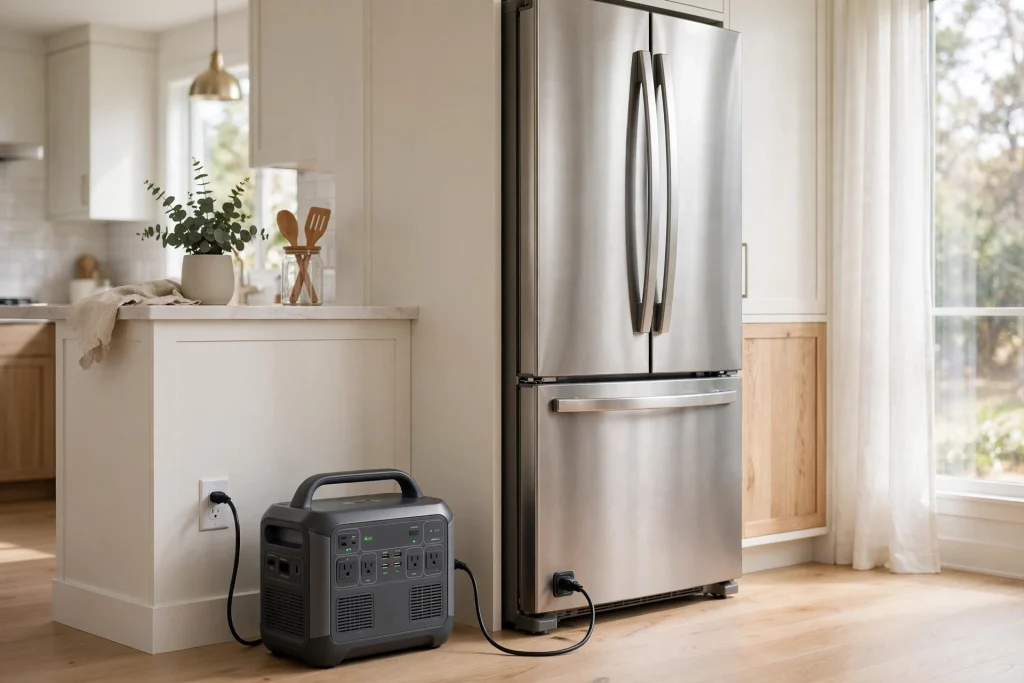
The first question in almost every outage is not about lights or phones. It is about the fridge, and how long the food inside stays safe. The honest answer is that a portable power station can run a refrigerator for hours, not days, and the real number depends on three things you can check before you buy: the fridge’s average draw, the station’s usable capacity, and how often the compressor actually runs.
Key Specifications
- The formula: usable watt-hours divided by average fridge watts equals approximate runtime in hours
- Usable capacity: plan on about 85% of a station’s rated watt-hours after inverter losses
- Typical fridge draw: a modern full-size fridge draws roughly 100 to 200W while the compressor runs, and the compressor typically cycles about 30 to 40% of the time
- Worked example, 1,000Wh station: about 850Wh usable, which covers a standard fridge averaging around 150W when running for roughly 5 to 6 hours of compressor time, stretched across a longer real-world window by cycling
- Worked example, 2,000Wh station: about 1,700Wh usable, roughly double the 1,000Wh figures
- Surge check: the station’s continuous AC output and surge rating must handle the compressor starting, which can briefly draw 2 to 3 times the running watts
What Stands Out
The duty cycle is what makes fridge backup workable at all. If you multiply a fridge’s running watts by 24 hours, you get a scary number that overstates real use by more than double, because the compressor rests most of the time in a cool kitchen with the door closed. Published sizing guidance from Jackery, using 85% inverter efficiency and a 40% duty cycle, estimates a 1,000Wh station runs a standard fridge at about 150W average running draw for around 5.5 hours, a 2,000Wh station for around 11 hours, and a 3,000Wh station for around 16.5 hours. Treat those as planning estimates, not promises, because an older fridge or a hot room shortens them.
That math points to a clear buying rule. For an overnight outage where the fridge is the main load, the 2kWh class is the realistic starting point. A 1kWh station is a useful bridge for a few hours, a mini fridge, or a fridge plus almost nothing else. Anything smaller belongs on router and laptop duty instead.
Things to Know
Keep the door closed. Every opening lets cold air out and makes the compressor work harder, and a fuller fridge holds its temperature better than an empty one. You can also stretch runtime by powering the fridge in blocks, for example running it for an hour or two, then resting it while the door stays shut, rather than leaving it connected continuously. Finally, check the fridge nameplate inside the door for its rated amps and watts before you buy, and leave at least a 20% buffer on top of your estimate for other small loads like phones and lights.
Who Is It Best For?
Homeowners and renters who face short to overnight outages and want to protect groceries without a gas generator. If your outages regularly run past a day, look at a 2kWh or larger station with expansion batteries or solar input so you can recharge during the outage instead of only spending down the battery.
Verdict
Size for the fridge first and everything else second. A 2kWh LiFePO4 station is the sweet spot for overnight fridge backup for most homes, a 1kWh unit buys you several useful hours, and the duty cycle, not the headline watts, is the number that decides how your food fares
To size for your own fridge and other loads, try our interactive sizing calculator..
Check the current price of the EcoFlow DELTA 2, a 1kWh starting point