Affiliate Disclosure: Watt Wise Living is reader-supported. When you buy through links on our site, we may earn an affiliate commission at no extra cost to you.
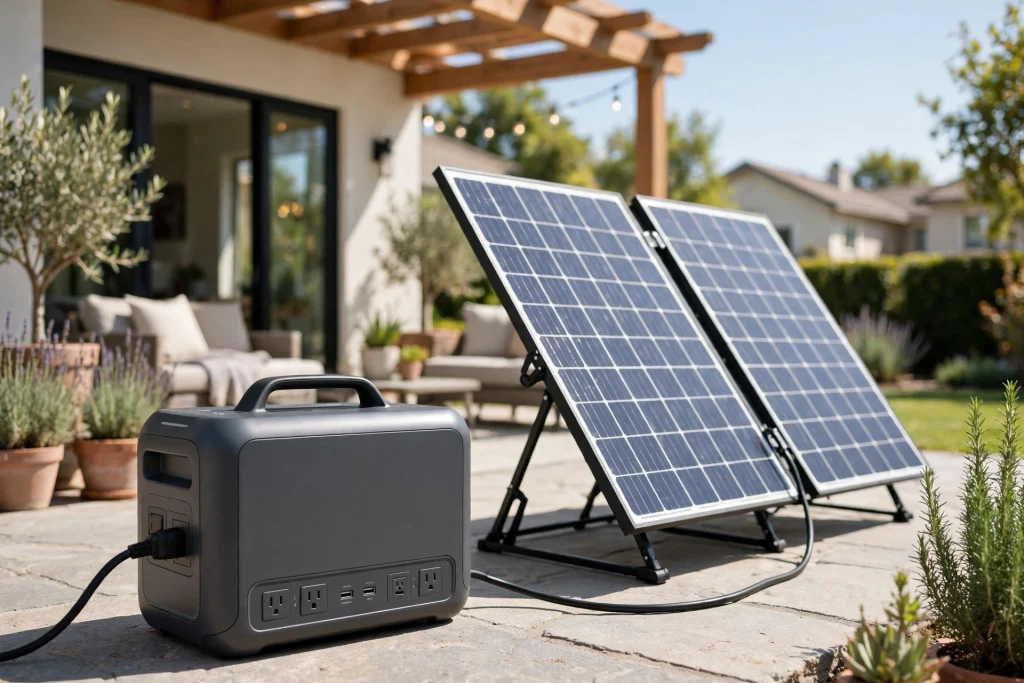
Solar panels are the part of a power station setup that buyers most often undersize. A single small panel on a big battery turns a one day recharge into a three day wait, while too much panel wastes money and can exceed what the station accepts. The good news is that the right size comes from one simple formula, plus an honest buffer for real weather.
Key Specifications
- The core formula: solar watts needed = battery Wh divided by peak sun hours
- Planning default: 4 peak sun hours a day for much of the US and southern Canada, less in winter or further north
- Real-world factor: panels typically deliver about 75 percent of rated watts in normal conditions, so size 20 to 40 percent above the ideal number
- 1,000Wh battery: about 250W of panel as a minimum, 300W for a comfortable one day refill
- 2,000Wh battery: about 500W of panel, such as two 200W panels plus headroom, or a 400W panel paired with a second smaller panel where the input allows
- Hard limit: never exceed the power station maximum solar input, in watts, voltage, or current
What Stands Out
Worked examples make the math stick. A 1,024Wh station, like the EcoFlow DELTA 3 Plus, divided by 4 sun hours gives a 256W target. One 200W panel gets you close on a bright summer day but falls short in spring or fall, which is why a 300W to 400W array is the practical pick. With just one 100W panel, that same battery needs roughly 13 to 14 hours of solid sun after losses, so it will not refill in a single day.
Your station solar ceiling decides how much of that array is usable. The DELTA 3 Plus accepts up to 1,000W of solar across two inputs, so it can actually use a large array and refill in about 70 minutes of strong sun. A station capped at 400W or 600W will clip extra panel power at midday, though a slightly oversized array still helps in the morning, late afternoon, and on cloudy days when output is low.
Things to Know
Peak sun hours are not daylight hours. A clear winter day in Toronto or Chicago may deliver only 2 to 3 peak hours, while a summer day in Arizona can deliver 6 or more. Shade is harsher than most people expect: a small shadow across one section can cut output sharply, so placement matters as much as panel count. Also remember pass-through use: if you run a fridge and a router while charging, your panels are feeding those loads first, and only the surplus refills the battery.
Who Is It Best For?
For outage-only backup, a modest array around 200W to 300W per 1kWh of battery is usually enough, because the grid does most refills. For camping, van use, cabins, or multi-day outage planning, size for a full daily refill with the buffer included, and pick a station whose solar input can accept that array. If your daily use is under 500Wh, one quality 200W panel is a sensible, affordable start.
Verdict
Divide your battery size by 4, add a third for real-world losses, and stay inside your station solar input limit. That one habit prevents almost every disappointing solar setup, and it scales cleanly from a small apartment unit to a 5kWh home system. If you have not chosen a station yet, start with our sizing guide.
Check the current EcoFlow DELTA 3 Plus price, a high solar input pick
Check the current Jackery Explorer 1000 V2 solar bundle price