Affiliate Disclosure: Watt Wise Living is reader-supported. When you buy through links on our site, we may earn an affiliate commission at no extra cost to you.
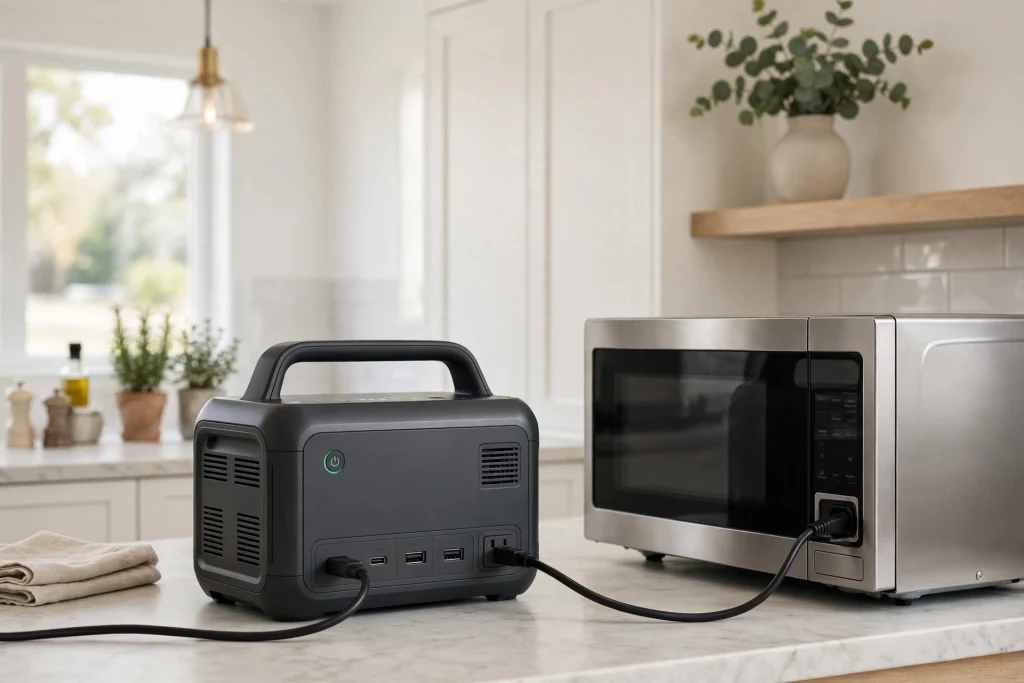
A microwave is one of the most common outage questions, and one of the most misunderstood. It draws a lot of power, but only for a few minutes at a time. That makes it a minutes, not hours, load: the deciding factor is usually whether the power station is strong enough to run it at all, not how big its battery is.
Key Specifications to Check
- Microwave input watts: Use the label on the back or inside the door, not the cooking power on the front. A microwave sold as 1,000W cooking power often draws about 1,500W of input power.
- Typical input range: About 1,000W for a small compact model, 1,350W to 1,550W for a common mid-size model, and up to about 1,700W for a large model, based on sizing guides checked 2026-10-24.
- Station rule: The power station continuous AC output must be higher than the microwave input draw.
- Runtime formula: Total cooking minutes = battery Wh x 0.85, divided by input watts, times 60.
What the Math Looks Like
At 85% usable capacity, a 1,024Wh station holds about 870Wh of usable AC energy. Divided by a 1,500W microwave draw, that is about 35 minutes of total cooking time. A 2,048Wh station doubles that to about 70 minutes, and a 2,073.6Wh station such as the Bluetti Elite 200 V2 lands in the same range.
In practice, nobody runs a microwave continuously in an outage. At 5 minutes per use, 35 minutes of cooking time is about seven reheats, and 70 minutes is about fourteen. The energy cost per use is modest: a 1,500W microwave run for 10 minutes uses about 250Wh before inverter losses. What rules most small stations out is output, not energy.
Things to Know
Run the microwave on its own. Do not run a microwave, a coffee maker, a toaster oven, or a space heater from the same station at the same time, even if each one works alone. Combined draws add up fast and will trip the inverter.
A 1,800W station, such as the EcoFlow DELTA 3 Plus at 1,800W continuous, can handle a compact or mid-size microwave whose label stays under that limit, with little headroom to spare. For a full-size microwave drawing 1,500W to 1,700W, a 2,400W to 2,600W station is the safer match. Small 600W stations cannot run a typical household microwave at all, no matter how the runtime math looks.
Who Is It Best For?
Anyone planning outage meals around reheating, soup, and frozen dishes rather than full cooking. If hot food matters during a blackout, size the station for the microwave label first, then check that the remaining capacity still covers your fridge, lights, and phones.
Verdict
Yes, a power station can run a microwave, as long as its continuous output beats the microwave input watts on the label. Pick a 1,800W or larger station for a compact model, and a 2,400W or larger station for a full-size one, and budget roughly 35 minutes of cooking per 1kWh of battery at a 1,500W draw.