Affiliate Disclosure: Watt Wise Living is reader-supported. When you buy through links on our site, we may earn an affiliate commission at no extra cost to you.
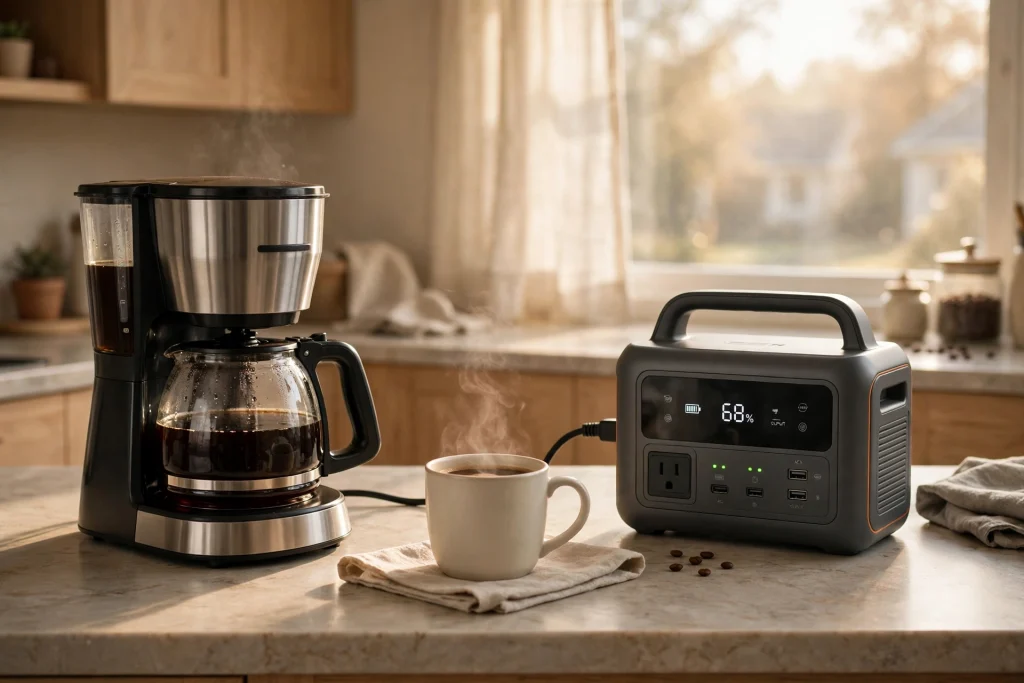
For many households, coffee is the first thing missed in a power outage. The good news is that a coffee maker is a short, predictable load, so most mid-size power stations can handle it. The catch is the peak draw: heating water takes a lot of watts, even if it only lasts a few minutes. Here is how to size it properly.
Key Numbers
- Small drip maker (4 cup): about 550 to 750W while brewing
- Standard drip maker (10 to 12 cup): about 750 to 1,200W while brewing, then 40 to 200W on the warming plate
- Single-serve pod machine: about 900 to 1,500W, peaking during heat-up
- Home espresso machine: about 1,000 to 1,500W
- Brew time: roughly 2 to 4 minutes per pod cup, 5 to 10 minutes for a full drip pot
- Energy per brew: watts multiplied by hours, so a 1,000W drip maker brewing for 10 minutes uses about 167Wh
What Stands Out
Two different limits decide whether your station can make coffee. The first is output: the inverter rating must beat the brewer peak draw. A pod machine that spikes to 1,500W will trip a 1,000W station even though each cup uses very little energy. Look for at least 1,500W of continuous AC output to cover most home brewers, and 1,800W if you run a larger espresso machine.
The second limit is capacity, and here coffee is cheap. Using the standard planning rule of about 85% usable battery, a 1,024Wh station gives you roughly 870 usable watt-hours. That is about 5 full pots from a 1,000W drip maker, or well over 10 pod cups at roughly 75Wh each. Even a small 286Wh station can brew a few pod cups, as long as its inverter can handle the peak, which is exactly where small units often fall short.
Things to Know
Check the rating label on your own brewer before you buy a station, because two machines that look alike can differ by 500W. Turn the warming plate off after brewing to save energy, since it can quietly eat 40 to 200W for as long as it sits on. And avoid running the coffee maker at the same time as another big load like a microwave, because combined draws are what trip inverters.
Who Is It Best For?
Anyone planning outage comfort, camping coffee, or RV mornings. If coffee is non-negotiable, size the station for the brewer first and everything else second: 1,500W or more of output, and 1kWh or more of capacity if you also want lights, phones, and a router running alongside.
Verdict
Yes, a power station can run a coffee maker, and it barely dents the battery. Just match the inverter to the peak draw on your brewer label. A 1kWh class station with 1,800W output, like the EcoFlow DELTA 3 Plus, covers drip, pod, and most espresso machines with room to spare.