Affiliate Disclosure: Watt Wise Living is reader-supported. When you buy through links on our site, we may earn an affiliate commission at no extra cost to you.
If you work from home, an outage is not just an inconvenience. It is a dropped call, a missed deadline, and a router blinking red while your phone hotspot drains. The good news is that a home office is one of the easiest loads to back up, because laptops and networking gear sip power compared with kitchen appliances. The trick is sizing honestly, so you buy enough capacity for a full workday without paying for a station built to run a fridge.
Key Specifications
- Wi-Fi router: typically 5 to 20W. A separate modem adds roughly 5 to 15W
- Laptop: typically 30 to 60W in use, with a charger rated around 65W at peak
- Monitor: a 22 to 24 inch desktop monitor typically draws 20 to 60W
- Typical laptop desk total: about 115W for a router, modem, laptop, and one monitor running together
- Desktop PC warning: a desktop tower draws roughly 60 to 200W at idle to moderate load, and a gaming PC can draw 300 to 600W or more under load
- The formula: usable watt-hours, about 85% of rated capacity after inverter losses, divided by your total watts equals approximate runtime in hours
- Small station example: EcoFlow RIVER 3 Plus, 286Wh and 600W output, about 2 hours for the 115W desk above
- Workday example: EcoFlow DELTA 3 Plus, 1,024Wh and 1,800W output, about 7 to 8 hours for the same desk. Listed at US$699 at REI, checked 2026-10-18
What Stands Out
The router is the highest value load in the house. At roughly 10W, keeping the router and modem alive costs almost nothing in capacity terms, yet it preserves your internet, your calls, and your ability to tell your team what is happening. Any station on this page can run networking gear for many hours. It is the monitor and the computer that decide what size you actually need.
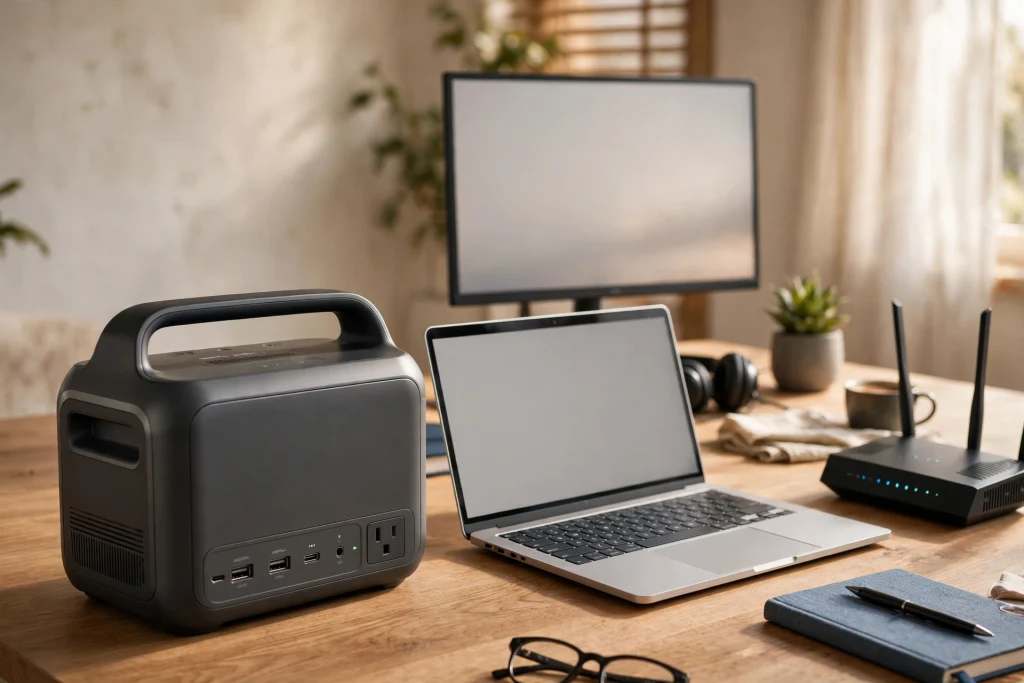
Run the math for the common laptop setup. Router and modem at about 20W combined, a laptop at about 50W average, and one monitor at about 35W gives a working load near 105 to 115W. A 286Wh station offers about 243Wh usable, so roughly 2 hours of full desk work, or much longer if you close the monitor and work on the laptop screen alone. A 1,024Wh station offers about 870Wh usable, which covers a full workday at that load with a small buffer for phone charging and a desk lamp.
Things to Know
Two habits stretch any station further. First, charge the laptop, then unplug it and work on its internal battery while the station powers only the router and monitor, topping the laptop up in short bursts. Second, check the switchover speed if you want protection mid-call: look for a UPS mode rated at 10 to 20ms so the router does not reboot when the grid drops. Desktop owners should size up without debate. A tower plus two monitors can triple the laptop load, which turns a workday target into a 2kWh purchase.
Who Is It Best For?
Laptop workers who lose income when the power drops and want a quiet, indoor-safe backup that lives under the desk. If your outages are usually under two hours, a compact 300Wh class station is enough. If you need a guaranteed full workday, or you run a desktop, step up to the 1kWh class or larger from the start.
Verdict
Size for the desk you actually have. About 115W is the planning number for a typical laptop setup, roughly 2 hours from a 286Wh station and a full workday from a 1,024Wh station. Keep the router on the list first, do the division before you buy, and your next outage becomes a minor story instead of a lost day
To run the numbers for your own desk, try our interactive sizing calculator..
Check the current price of the EcoFlow RIVER 3 Plus, the compact option
Check the current price of the EcoFlow DELTA 3 Plus, the full workday option