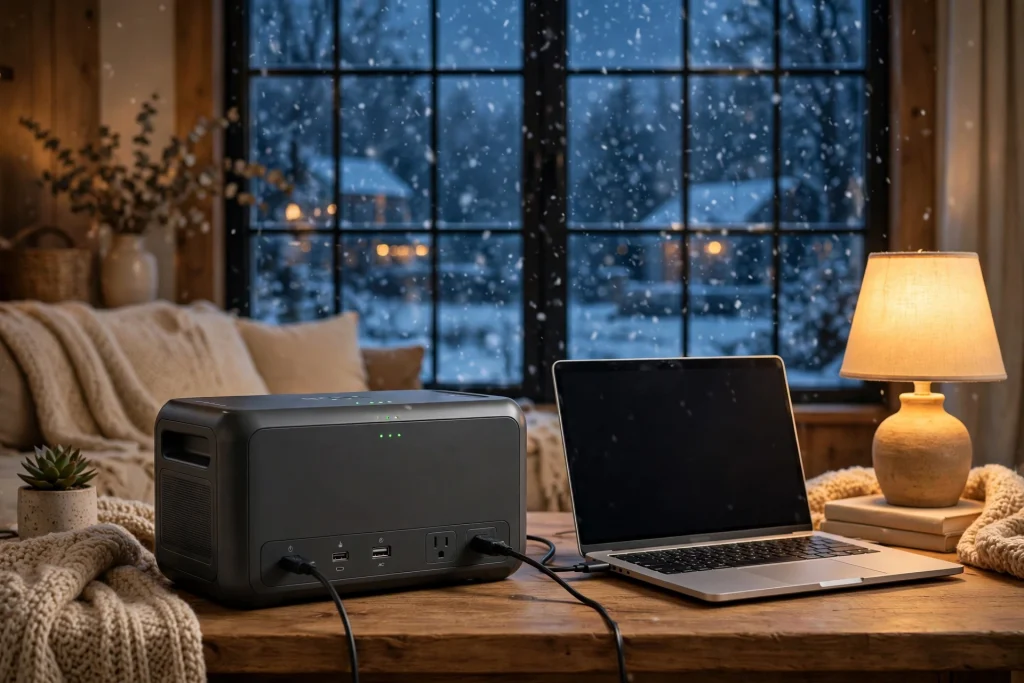
Winter storms cause the longest outages of the year, and cold is the one condition that quietly shrinks your backup power. A little preparation keeps every watt-hour usable.
Key Takeaways
- Most LiFePO4 stations can discharge down to about -10°C (14°F) but should only be charged at 0°C (32°F) or above. The EcoFlow DELTA 3 Plus is rated for charging at 0 to 45°C and discharging at -10 to 45°C.
- Charging a lithium battery below freezing can cause lithium plating, which permanently reduces capacity. A good battery management system refuses the charge instead.
- Store and charge your station indoors, top it up before a storm warning, and expect shorter runtimes on the coldest nights.
A portable power station is at its best in a warm living room and at its worst in an unheated garage in January. The chemistry inside does not stop working in the cold, but it does slow down, and the rules for charging change completely.
Why does cold matter so much for a power station?
Two separate limits apply, and confusing them causes most winter problems. Discharging is the forgiving direction: most LiFePO4 stations are rated to run loads down to about -10°C. Charging is the strict direction: the typical rated charging range starts at 0°C. Below that, pushing current into a lithium cell can plate metallic lithium onto the anode, which is permanent damage, not a temporary slowdown. That is why a station left in a cold garage may happily power your fridge yet show 0W of solar or AC input. It is protecting itself, not broken.
Cold also trims usable capacity, so a station that runs your home office for eight hours in October may give you noticeably less on the coldest night of February. Plan your sizing with winter margin, the same way our sizing guide adds a safety factor to the math.
Where should your power station live in winter?
Indoors, at room temperature, near the loads it will actually run. A hallway closet or a corner of the home office beats the garage, the shed, and the car every time. Indoor storage keeps the battery inside its charging range, costs you no runtime to the cold, and puts the unit within cord reach when the lights go out. If your station has been sitting somewhere cold, bring it inside and let it warm to room temperature before charging. A few hours is usually enough for a unit that was merely chilly; overnight is safer after a deep freeze.
How do you prepare before a winter storm?
- Charge early. When a storm warning appears, charge to full indoors while the grid is still up. The EcoFlow DELTA 2 class of 1kWh stations refills in about an hour.
- Keep solar panels ready, not buried. Panels still produce on bright winter days. Tilt them so snow slides off, and brush them clear before you need the power.
- Know your first loads. Fridge, router, phone chargers, and a lamp are the usual first hour list. Resist the space heater: it can drain a 1kWh station in under an hour.
- Check on CPAP users. A winter outage plus a medical device deserves its own plan; our CPAP sizing guide runs the numbers.
What if you must use a station outdoors in the cold?
Sometimes the job is outdoors: ice fishing, a winter worksite, a cabin with no heated space. Stay inside the discharge rating, keep the unit off the snow and out of the wind, expect reduced runtime, and charge it again only once it is back in a warm space. Self-heating cold-rated models exist for this niche, but for most households in the US and Canada, the indoor routine above covers every realistic outage.
Frequently Asked Questions
Can I charge a power station below freezing?
For most lithium models, no. Typical rated charging ranges start at 0°C (32°F), and the battery management system will usually block charging below that to prevent lithium plating. Warm the unit indoors first, then charge.
Can a power station sit in an unheated garage all winter?
It can sit there within its storage temperature range, but it will lose runtime, refuse to charge while cold, and need hours of warming before a storm recharge. Indoor storage at room temperature is the better habit.
Do solar panels work in winter?
Yes. Cold, sunny days are fine for panels, and output can be strong in clear winter light. The limits are shorter days and snow cover, so keep panels tilted and brushed clear.
The Bottom Line
Winter does not defeat a power station, but it punishes a cold one. Store it indoors, charge it before the storm, respect the 0°C charging floor, and leave the space heater out of the plan. If you are shopping with winter in mind, start with a 1kWh LiFePO4 model such as the EcoFlow DELTA 3 Plus (1,024Wh, 1,800W output, seen at CA$749 on Amazon.ca, checked October 16, 2026; prices move daily) or browse the models we have already reviewed.
Check the current price of the EcoFlow DELTA 3 Plus
Affiliate Disclosure: Watt Wise Living is reader-supported. When you buy through links on our site, we may earn an affiliate commission at no extra cost to you.