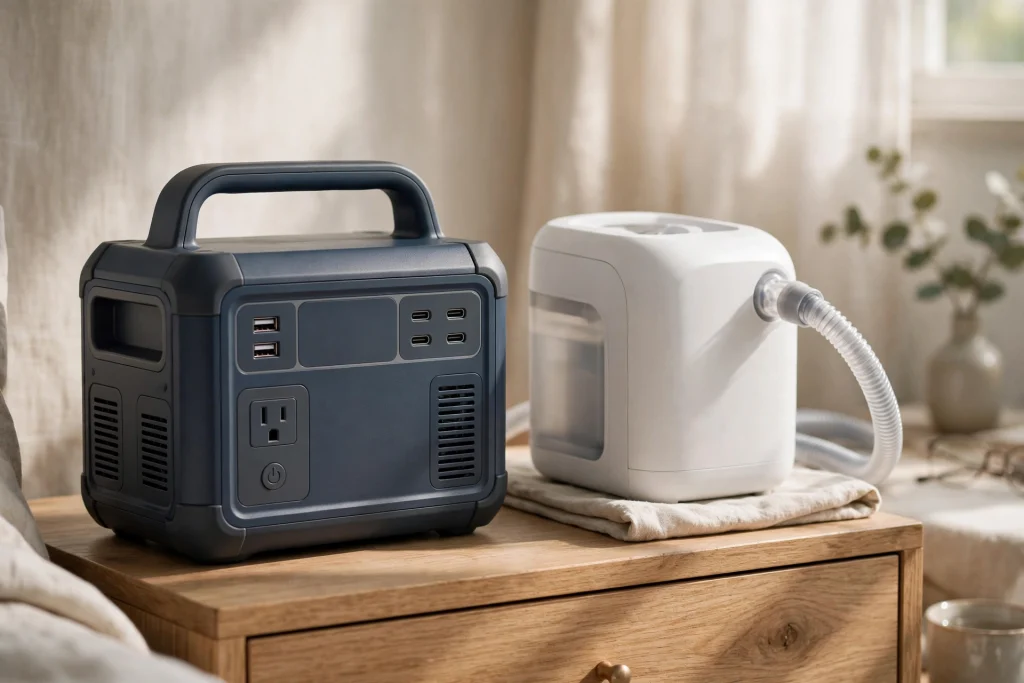
A CPAP is one of the easiest devices to back up, and one of the easiest to oversize. Three steps, real math, no guesswork.
Key Takeaways
- Most CPAP machines draw 20-40W without heated humidification and 70-90W with it on, with peaks up to 100W.
- One night costs roughly 160-320Wh with the humidifier off, 480-720Wh with it on.
- Rule of thumb: humidifier off needs a 400Wh+ station; humidifier on needs a 1kWh station.
A power outage should not cost you a night of sleep. The good news: a CPAP machine sips power compared to a refrigerator or a space heater. The bad news: the heated humidifier changes the math completely. Here is how to size a power station for your exact setup.
Step 1: Find your machine’s wattage
Check the label on the power brick or look up your model’s specs. Most modern CPAP machines draw 20-40 watts while running without heated humidification. With a heated humidifier or heated tubing, that climbs to 70-90 watts typical, and some setups can spike toward 100-120 watts on startup or at high heat settings.
For reference, the popular ResMed AirSense 10 is rated at 53W typical and 104W peak with its heated humidifier attached. Travel CPAP models are the stingiest of all, often drawing just 5-20 watts. If you cannot find a number, use 40W without a humidifier and 80W with one.
Step 2: Decide about the humidifier
This is the biggest lever in the whole calculation. Turning the humidifier off, or running it on its lowest setting, can cut your energy need roughly in half. For one outage night, many people accept a drier night in exchange for a much smaller, cheaper station.
Tip: if your machine has a 12V DC converter option, use it. Running on DC skips the AC inverter losses and stretches runtime. Check with your equipment provider that a battery backup is fine for your model.
Step 3: Do the math
Watts x hours x 1.2 = the watt-hours you need. The 1.2 multiplier is a safety margin for inverter losses and battery reserve, and it keeps you from waking up to a dead station at 5 a.m.
Worked example: a ResMed AirSense 10 at 53W typical with the humidifier on, for 8 hours: 53 x 8 = 424Wh, times 1.2 = about 510Wh. That points to a 1kWh-class station. Same machine with the humidifier off at 35W: 35 x 8 = 280Wh, times 1.2 = about 336Wh, so a 400Wh-class station covers it with margin.
Per-night reality check from the data: no humidifier costs about 160-320Wh per 8-hour night; humidifier on low to medium costs 480-720Wh; high heat in a cold room pushes 720-960Wh.
Quick picks by situation
Humidifier off, one night: the EcoFlow RIVER 3 Plus with 286Wh of LiFePO4 and 600W of output covers a 20-30W machine for a full night at around CA$399.99. Want margin for longer nights? The BLUETTI AC2A’s 204Wh is too tight here; the RIVER 3 Plus is the compact sweet spot.
Humidifier on, one night: step up to the 1kWh class. The Anker SOLIX C1000 Gen 2 (1024Wh, 2000W, around CA$699) handles a full humidified night with headroom to spare. Its natural rival is the EcoFlow DELTA 2 at a similar price.
Multi-night outage insurance: go 2kWh. The EcoFlow DELTA 2 Max (2048Wh) or the Anker SOLIX C2000 Gen 2 (2,048Wh) cover two humidified nights easily, with capacity left for a lamp and phone charging. If you are still unsure how much capacity to buy, our power station sizing guide runs the full math.
Frequently Asked Questions
How many watts does a CPAP use?
Most draw 20-40W without heated humidification and 70-90W with a heated humidifier or heated tubing, with startup or high-heat spikes up to about 100W. Travel models can draw as little as 5-20W.
What size power station do I need for one night of CPAP?
With the humidifier off, about 336Wh with a safety margin, so a 400Wh-class station works. With the humidifier on, plan for about 510Wh, which points to a 1kWh-class station. The formula is watts x hours x 1.2.
Can a small 300Wh station run a CPAP all night?
With the humidifier off, usually yes for a single night: an 8-hour night at 30W is 240Wh, and a station like the EcoFlow RIVER 3 Plus holds 286Wh. With the humidifier on, no; you need a 1kWh-class station.
Should I use a 12V DC adapter for my CPAP?
If your machine supports one, yes. Running on DC avoids the AC inverter conversion loss, so the same station lasts longer. Check with your equipment provider before buying a third-party adapter for a medical device.
The Bottom Line
Skip the humidifier and a compact 300Wh-class station gets you through one night. Keep the humidifier on and buy a 1kWh station like the Anker SOLIX C1000 Gen 2. Cover a multi-day outage with a 2kWh unit. The math is simple: watts x hours x 1.2, then buy the smallest station that clears the number.
Affiliate Disclosure: Watt Wise Living is reader-supported. When you buy through links on our site, we may earn an affiliate commission at no extra cost to you.