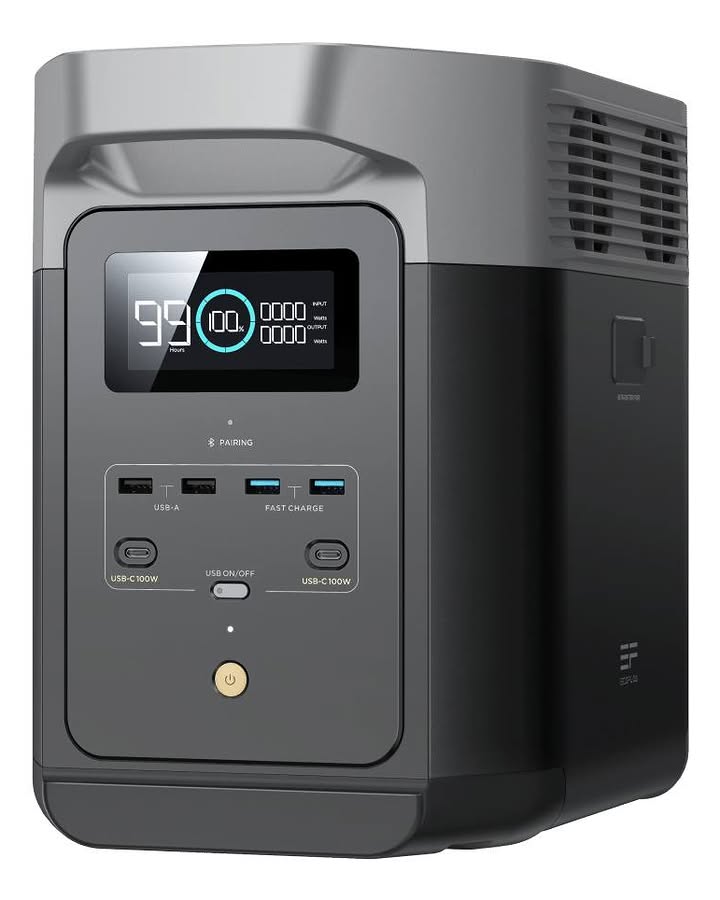
It charges faster than anything else in its class. That is the whole pitch, and it is enough.
Key Takeaways
- Charging speed is the DELTA 2’s defining trait. Solar recharge takes 3 to 6 hours with compatible panels.
- Smart MPPT algorithm delivers over 98% solar efficiency, measurably better than many rivals.
- Expandable ecosystem: add extra batteries later as your needs grow.
- Around CA$648.
How fast does the DELTA 2 recharge on solar?
Three to six hours from empty to full with compatible panels. EcoFlow’s MPPT smart algorithm detects voltage and current in real time, squeezing over 98% efficiency out of your solar input. That is measurably better than many competitors.
If your outage pattern is “storm warning at noon, blackout at 6pm,” fast turnaround between charges is not a nice-to-have. It is the feature. Before you commit to any unit, run your numbers through our power station sizing guide.
An ecosystem, not just a box
Start with the base unit for apartment or home-office backup. Add extra batteries later if your needs grow. Most fixed-capacity rivals cannot offer that path, and it makes the DELTA 2 a safer long-term bet than units you outgrow. The Jackery Explorer 1000 V2 is its closest fixed-capacity rival.
What to check before you buy
Confirm the exact capacity and output specs on the listing, and size the unit against your must-run devices. Every power station purchase should start with your load list, and this one is no exception. If you want the fastest-charging compact instead, look at the EcoFlow RIVER 3 Plus.
| Solar charging | 3 to 6 hours (compatible panels) |
|---|---|
| MPPT efficiency | Over 98% |
| Expandable | Yes, extra batteries and solar panels |
| Price | Around CA$648 |
What we like
- Fastest recharge in the mid-size class
- Expandable battery ecosystem
- Over 98% solar efficiency
What we’d change
- Confirm capacity and output on the listing before buying
- Fixed base capacity without add-on batteries
Frequently Asked Questions
How fast does the EcoFlow DELTA 2 charge?
On solar, it recharges in 3 to 6 hours with compatible panels. The smart MPPT algorithm actively tracks voltage and current in real time to deliver over 98% efficiency, which is why the DELTA 2 refills faster than most mid-size rivals.
Is the DELTA 2 expandable?
Yes. It works with extra batteries and a range of solar panels, so you can start with the base unit for apartment or home-office backup and add capacity later. That flexibility is rare among fixed-capacity competitors.
How much does the EcoFlow DELTA 2 cost?
It sells for around CA$648. Given the charging speed and expandable ecosystem, it is competitively priced against other mid-size stations that charge more slowly and cannot grow with your needs.
Who should buy the DELTA 2?
Anyone who values recharge speed above all else. If your outage pattern is a storm warning at noon and a blackout at 6pm, the DELTA 2’s fast charging is a genuine advantage. It also suits buyers planning to build out a solar setup over time.
The Bottom Line
Buy it if recharge speed is your top priority, or if you plan to build out a solar setup over time. Skip it if you want a simple fixed-capacity unit with no expansion plans. For fast turnaround, it deserves the top spot on your shortlist.
Check the current price on Amazon
Affiliate Disclosure: Watt Wise Living is reader-supported. When you buy through links on our site, we may earn an affiliate commission at no extra cost to you.
▸ Compare similar Mid-size models
| Model | Capacity | Output | Price (CAD) |
|---|---|---|---|
| EcoFlow DELTA 2 This review | 1,024Wh | 1,800W | $648.00 |
| DJI Power 1000 Mini | 1,008Wh | — | $649.00 |
| DJI Power 1000 V2 | 1,024Wh | 2,600W | $699.00 |
| Anker SOLIX C1000 Gen 2 | 1,024Wh | 2,000W | $699.00 |
Specs per manufacturer listings; prices in CAD as listed October 2026 and change daily. Tap a model to read its full review.